Gateway WAF
This feature is tech preview. Tech preview features may be subject to significant changes before they become GA.
Big picture
Protect the traffic entering your cluster through Calico Ingress Gateway with a web application firewall (WAF) that you attach per Gateway or per route, and tune per namespace.
Value
Edge WAFs traditionally apply one ruleset to everything behind the gateway. Gateway WAF takes a Kubernetes-native, multi-tenant approach: a cluster operator sets a security baseline once, and each application team layers its own rules and exceptions on top — scoped to their own Gateways and HTTPRoutes, within guardrails the cluster operator defines.
Gateway WAF runs the industry-standard OWASP ModSecurity Core Rule Set v4 as a Coraza WebAssembly filter inside Envoy Gateway — no sidecars, and no traffic ever leaves the proxy for inspection.
How it works
Gateway WAF is configured entirely through Kubernetes resources. The controller merges every policy and plugin that applies to a target, generates an ordered list of ModSecurity directives, validates the result, and programs it into Envoy Gateway as an EnvoyExtensionPolicy that loads the Coraza WASM filter.
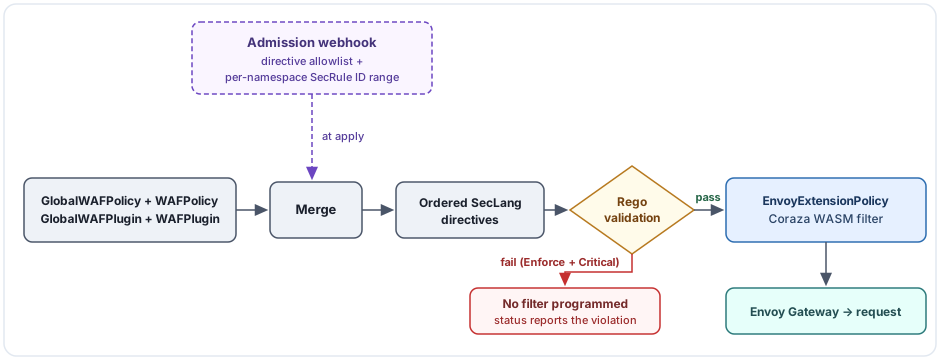
The inputs to the merge are GlobalWAFPolicy + WAFPolicy and GlobalWAFPlugin + WAFPlugin. Two guardrails apply: the admission webhook (structural, at write time) and validation policies (compliance, after the merge).
Who does what
Gateway WAF is configured through six custom resources in the applicationlayer.projectcalico.org/v3 API group, in three families. Each family splits cleanly across two personas: a cluster-scoped resource owned by the cluster operator (CO), and a namespace-scoped resource owned by the application operator (AO).
| Family | Cluster operator (CO) | Application operator (AO) | Answers the question |
|---|---|---|---|
| Policy | GlobalWAFPolicy — cluster-wide baseline (singleton, name: default) | WAFPolicy — attach WAF to a Gateway/HTTPRoute (targetRefs); per-namespace overrides | What to enforce — action, Core Rule Set state, paranoia, which plugins |
| Plugin | GlobalWAFPlugin — organization-wide custom rules | WAFPlugin — app-specific rules and false-positive exceptions | Which custom rules to add, in ModSecurity SecLang |
| Validation | GlobalWAFValidationPolicy — compliance guardrails (Enforce/Audit) | WAFValidationPolicy — advisory self-check, never blocks | Whether a configuration is allowed — compliance guardrails |
Enabling the feature itself (the GatewayAPI gate) is a one-time cluster operator step — see Enable the feature — everything above is ongoing configuration once it's on.
The cluster operator sets the posture; the application operator tunes it — can go stricter, but can be stopped from going weaker (see Validation and enforcement).
Policies — what to enforce
A policy declares the action mode (Detect/Block), whether the Core Rule Set is enabled, the paranoia level, and which plugins to load.
GlobalWAFPolicy— cluster-wide singleton (name: default), sets the baseline for every namespace.WAFPolicy— namespace-scoped, attaches WAF to a Gateway/HTTPRouteviatargetRefs, can override the baseline action and paranoia.
Plugins — custom rules
A plugin holds custom ModSecurity rules in four lifecycle slots — config, before, rules, after — modeled on the Core Rule Set 4 plugin system. Referenced from a policy's spec.plugins[]; does nothing on its own.
GlobalWAFPlugin— organization-wide rules: security baselines, compliance rules.WAFPlugin— application-specific rules and false-positive exceptions.
Each slot runs at a fixed point in the merge, so slot choice decides when your rules fire:
| Slot | Runs | Use for |
|---|---|---|
config | Before Core Rule Set setup | tx.* variable setup (anomaly thresholds, optional features, app flags). Rules on request variables belong in before instead — the request isn't read yet |
before | After variable setup, before Core Rule Set loads | Early-exit allowlisting of trusted paths, request normalization, flags for later rules |
rules | Alongside Core Rule Set, after it (Tigera extension) | App-specific detections that complement rather than pre-empt the Core Rule Set; can act on anomaly scores |
after | Last | False-positive suppression, response inspection, logging. GlobalWAFPlugin.after runs after namespace WAFPlugin.after, so the cluster operator has final say |
For the full merge sequence across every policy and plugin, see merged ruleset load order; to write plugin rules, see Write custom rules.
Validation policies — guardrails
A validation policy carries Rego rules evaluated against the merged, effective configuration — answering "is this acceptable?", e.g. "Core Rule Set must stay enabled" or "production must run in Block mode."
GlobalWAFValidationPolicy— enforced by the cluster operator:Enforcemode blocks programming on acriticalviolation,Auditmode only warns.namespaceSelectorscopes which namespaces it applies to.WAFValidationPolicy— advisory only, surfaces violations on status for the application operator to act on, never blocks. No enforce mode at namespace scope.
(Validation policies aren't the admission webhook — see Validation and enforcement for the distinction.)
The global policy is a singleton
GlobalWAFPolicy is a cluster-wide singleton — must be named default. It sets the baseline (default action, Core Rule Set state, paranoia level) every namespace inherits unless it overrides.
GlobalWAFPlugin and GlobalWAFValidationPolicy are not singletons — create as many as needed.
Inheritance: namespaces override, they don't restart
A WAFPolicy doesn't have to restate the whole baseline — its action and coreRuleSet fields are optional; unset fields inherit from GlobalWAFPolicy.
apiVersion: applicationlayer.projectcalico.org/v3
kind: WAFPolicy
metadata:
  name: payments-waf
  namespace: payments
spec:
  targetRefs:
    - group: gateway.networking.k8s.io
      kind: HTTPRoute
      name: payments-api
  action: Block          # override the global default for this namespace
  coreRuleSet:
    paranoiaLevel: 2      # stricter than the baseline
  # coreRuleSet.state is unset → inherited from GlobalWAFPolicy
WAFPolicy field | When set | When unset |
|---|---|---|
action | overrides the global defaultAction for this namespace | inherits GlobalWAFPolicy.spec.defaultAction |
coreRuleSet.state | overrides the global state | inherits the global state |
coreRuleSet.paranoiaLevel | overrides the global level | inherits the global level |
Plugins are additive, not overriding
Plugins stack rather than override. The merger applies all referenced global plugins first (GlobalWAFPolicy.spec.plugins[] order), then all namespace plugins (WAFPolicy.spec.plugins[] order) — order is array position; there's no priority field.
This lets baseline rules and application exceptions coexist in one ruleset — the interleaving, and why global after runs last, is covered below.
Merge order and enforcement
When a WAFPolicy attaches to a target, the controller gathers every applicable policy and plugin, merges them into one ordered list of ModSecurity directives, validates the result, and programs it into Envoy Gateway as an EnvoyExtensionPolicy. Each targetRefs[] entry produces its own EnvoyExtensionPolicy — three routes means three filters.
Three things govern the outcome: merge order, the admission webhook, and validation policies.
The merged ruleset load order
Directive order isn't cosmetic: the Core Rule Set needs variables set before loading, and post-processing after. Fixed order:
Engine setup
SecRuleEngine On/DetectionOnly— the effective action mode from the merged config.- Engine settings — audit logging and request-body access.
Plugin config (variable setup)
3. Global plugin config blocks, in GlobalWAFPolicy.spec.plugins[] order.
4. Namespace plugin config blocks, in WAFPolicy.spec.plugins[] order.
Core Rule Set setup
5. Core Rule Set setup — reads the tx.* variables set above.
6. Blocking paranoia level, from the merged paranoia level.
7. Detection paranoia level (always ≥ blocking level).
Pre-Core Rule Set rules (before)
8. Global plugin before rules.
9. Namespace plugin before rules.
Core Rule Set 10. The full OWASP Core Rule Set.
Custom rules (rules)
11. Global plugin rules.
12. Namespace plugin rules.
Post-processing (after)
13. Namespace plugin after rules.
14. Global plugin after rules — runs last, giving the cluster operator the final say on anomaly scoring and logging.
Pattern: global-before-namespace in the early slots, namespace-before-global in after. Within a plugin, its own slots always run config → before → rules → after.
When two WAFPolicy resources target the same route, Calico Cloud follows Gateway API GEP-713: oldest creationTimestamp wins (ties by namespace/name). The loser is marked Accepted=False reason Conflicted, directives not merged.
Structural safety: the admission webhook
Before any of the above runs, a validating admission webhook checks the raw SecLang in a WAFPlugin or WAFPolicy at apply time, rejecting the resource if any directive fails one of three checks:
| Check | Passes when | Rejected with |
|---|---|---|
| Directive is allowed | the directive type is on the allowlist (SecRule, SecAction, SecRuleRemoveById, and other safe directives) | UnsafeDirective |
| Rule ID is in range | a SecRule/SecAction ID falls inside the namespace's allocated ID range | IDOutsideRange |
| Removal is permitted | a SecRuleRemoveById targets an ID inside the namespace's own range, not a protected baseline rule | ProtectedIDRemoval |
This stops one namespace colliding with another's rule IDs, or disabling the cluster's baseline Core Rule Set rules. Each namespace gets an automatic 10,000-ID range; see SecRule ID ranges for how it's derived and which IDs are protected.
Validation and enforcement
The admission webhook checks raw SecLang; validation policies check the merged result, running after the merge because some problems only show up there. Two innocent plugins can combine to disable all SQL-injection rules — invisible to admission-time checks, but visible to a Rego rule against the merged directive list.
Validation rules are Rego modules with severity info, warning, or critical. What happens on a violation depends on the policy:
| Validation policy | Mode | critical violation | warning / info violation |
|---|---|---|---|
GlobalWAFValidationPolicy | Enforce | blocks — no filter is programmed; status reports the rejection | warns on status; filter still programmed |
GlobalWAFValidationPolicy | Audit (default) | warns on status; filter still programmed | warns on status; filter still programmed |
WAFValidationPolicy | advisory only | surfaces on WAFPolicy status; never blocks | surfaces on status; never blocks |
To write the rules, see Rego validation. To read the outcome, see Status conditions.
Next steps
- Enable the feature — turn on Gateway WAF and verify the CRDs and webhook.
- Tutorial — deploy a test app and block your first attack.
- Set a baseline, Attach WAF, Write custom rules, Validate config, Multi-tenant setup — production tasks.
- Reference — CRDs, Rego validation, SecRule ID ranges, and status conditions.
- Troubleshooting — diagnose common failure modes.